Notice: I've taken a part-time job, and it's definitely affecting my blogging time. I'll continue to add content here as often as possible. Pertinent guest posts are always welcome.

-
Showing posts with label Transportation Enhancements. Show all posts

Saturday, February 11, 2012

Contact Your Senator to Save Transportation Enhancement Money!

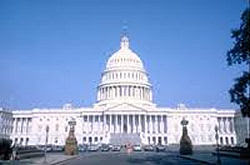
US capitol

from American Trails and other sources

Although the North Country Trail seeks to be mostly single-track woods trail, there are many places where our uses overlap with trails which are aided by these funds. One critical area is adding pedestrian walkways to bridges.

If you care about the NCT, please contact your Senator today! Voting could occur as early as Monday.

Last week, the House of Representatives dealt non-motorized transportation a serious blow by passing a bill that would eliminate Transportation Enhancements. This funding helps pay for things like multi-use trails, and the Safe Routes to School program.

Highway proponents have always complained about the requirement to cover other forms of transportation, other than powered vehicles. Media coverage of projects that seem frivolous hasn't helped.

Now, it's the Senate's turn. If you care about getting around for transportation and/or recreation without burning gas, please send an email today! Links below should make it as easy as possible.

The Senate's version of the transportation bill (MAP-21) does NOT include dedicated funding for the Recreational Trails Program. However, Senator Klobuchar (D-MN) will present an amendment to restore dedicated funding to RTP at the appropriate time. (The amendment could be offered as early as next week.) This would restore RTP authorization as a stand-alone program, as well as fund it at 2009 levels.

ACTION NEEDED: PLEASE CALL and ask your Senators to support Senator Klobuchar's amendment to restore dedicated funding for the Recreational Trails Program in the Senate transportation bill (MAP-21).

"ASK" FOR SENATORS:

As a user-pay/user-benefit program, dedicated funding for the RTP should be included in the Senate transportation bill (MAP-21). Will you support the Klobuchar amendment to MAP-21, which restores dedicated funding for the Recreational Trails Program? This amendment makes the Senate bill consistent with language that is already in the House bill.

There is a similar campaign to support an amendment to protect Enhancements and Safe Routes to School sponsored by Senator Cardin (D-MD) and Senator Cochran (R-MS) in the Senate transportation bill


See Talking Points
See Find Your Senator
See read more at American Hiking


Saturday, October 29, 2011

Transportation Enhancements Still Under Fire


a news release of Rails-to-Trails Conservancy

Transportation Enhancement Funds are meant to be applied to other forms of transportation than highways. These funds have benefited the North Country Trail in certain places where we follow urban pathways, or to provide pedestrian walkways on bridges. Although TE funds will never be a big portion of North Country Trail funding, this source of cash had been critical in building the country's multi-use trail system.

In his Senate Amendment 821, Senator Rand Paul (Ky.) is trying to force us to choose between safe bridges and safe places to walk and bike in our communities.

See RTC Vice President of Program Kevin Mills discussing in the video why we need your support:

Choosing between bridges and safe walking and bicycling is a false choice.

In truth, most states already have funds that they could use for bridge repair, but that instead go for new roadways. Further, last year, states sent back $530 million in unspent bridge funds.

It’s shameful and disingenuous to claim to be promoting safety by pushing to cut funds for trails, walking and bicycling when 47,000 cyclists and pedestrians have died during the past decade.

Sen. Paul’s is the third attack on TE in a single month.

In late September, Senator Tom Coburn (Okla.) attempted to eliminate dedicated funding for this crucial program. Working through a broad coalition, supported of trails joined together to send more than 50,000 messages to your senators, asking them to support TE.

Unfortunately, some in Congress believe that if they keep hammering away at a wildly popular, low-cost, highly efficient program, we’ll finally get tired and let them destroy a 20-year legacy of building a balanced transportation system.


See Rails to Trails

Wednesday, September 16, 2009

Transportation Amendments Defeated!


OutdoorBlips: vote it up!
from the American Hiking Society

American Hiking Society and other trail organizations asked you to call your Senator and respectfully request that they vote NO on two amendments that would have threatened significant funding for trails and the hiking experience. Moments ago, the entire Senate voted against these amendments. More than 500 people took action on short notice, and thanks to your voice, these damaging amendments were roundly defeated!

To view video of the recent votes, visit C-Span.org
See How your Senator voted

Tuesday, September 15, 2009

Make a Call or eMail To Save Transporation Enhancements


OutdoorBlips: vote it up!
from American Trails and the Rails-to-Trails Conservancy

Tomorrow, Sept 16, the US Senate will vote on the FY10 Transportation, Housing and Urban Development appropriations bill. Senators Coburn and McCain have teamed up to write an amendment which will gut the Transportaion Enhancement Fund that pays for many bicycle paths and paved pedestrian walkways. In an effort to bail out the Highway Trust Fund, they are seeking to eliminate funding for anything other than motorized transportation.

Despite the fact that some of these are required by law, the amendment calls non-motorized pathways "some of the many examples of extraneous expenditures." They are calling for the Transportation Department to set new priorities. Of course, if the Highway Trust Fund had been managed properly there would be no need to raid the enhancements.

McCain and Coburn state that the new priorities must be set because of the "realities of a collapsing transportation infrastructure." It seems as if they have forgotten that all the bike paths funded by enhancement dollars had to meet the criteria of "alternate transportation routes." Because of pedestrian and bicycle paths many people choose to stay off the roads, thus relieving some of the stress and congestion. The Safe Routes to School program has used these funds to make it possible for children to ride bikes or walk to school rather than being driven by parents.

If you think that, despite some highly publicized examples of misuse of Transportation Enhancement Funds, rails-to-trails, urban pathways, pedestrian walkways on bridges, and bicycle lanes on streets and highways have values, please contact your senator and ask him or her to vote against Amendments 2370 and 2371 to H.R. 3288.

Amendment 2370 would prohibit the use of federal funds for pedestrian or bicycle facilities, efforts to reduce vehicle collisions with wildlife, or other specified Transportation Enhancement (TE) projects if the Highway Trust Fund cannot cover unfunded highway authorizations.

Amendment 2371 would allow states to eliminate spending on TE, the nation’s largest funding source for trails, walking and bicycling. Congress currently sets aside a portion of federal funds for TE to support these projects in all states.

Read the Coburn- McCain amendment

Tuesday, March 10, 2009

Feature- North Dakota's Martinson Bridge

Sheyenne State Forest sign
(photo by JHY)
The North Dakota Department of Transportation and the State Historical Society of North Dakota often team together to restore and preserve old bridges. One of their previous projects is located in Ransom County, southeast of Fort Ransom State Park. It is known as the Martinson Bridge. The single-lane, true-truss bridge provides access to the Sheyenne State Forest and to the North Country Trail. A portion of the trail runs through North Dakota’s Sheyenne River Valley.

"You can cross the bridge to the North Country Trail, to get to a waterfall," said Ben Kubischta, NDDOT’s transportation enhancement program coordinator. "It’s a great place for hiking." The few miles of NCT in the Sheyenne State Forest are unique. The forest trail climbs several hills and passes the state's only waterfall.

Martinson Bridge
Martinson Bridge Restoration Sheyenne River, Ransom County (photo from ND DOT)
The Martinson Bridge was restored with Transportation Enhancement funds. Transportation Enhancements are transportation-related activities that strengthen the cultural, aesthetic and environmental aspects of the Nation's intermodal transportation system. They account for a small percentage of transportation funding. Occasionally TE funds benefit the North Country Trail in locations involving bridge crossings, urban pathways, or alternative transportation routes.

Martinson Bridge Trailhead
Martinson Bridge Trailhead (photo from SRV Chapter NCTA)
A one-and-a-half mile loop of the North Country Trail is located at the east end of the Sheyenne State Forest and contains some breathtaking views of the river valley. A one-half mile connector segment joins the Oak Ridge Loop to the Mineral Springs Segment at the Martinson Bridge Trailhead.

See North Dakota DOT
See Sheyenne River Valley Chapter NCTA
See Traill County's Bridges to History (free sign-up required)
See Transporation Enhancements Remain in Stimulus Package
See Some Transportation Enhancements Remain in Stimulus Package

Thursday, February 19, 2009

Transportation Enhancements Remain in Stimulus Package

from the Rails-to-Trails Conservancy

Transportation Enhancements have been used to benefit the North Country Trail in some specific instances. These funds can not be used for single-track backcountry trail. However they are often invaluable for solving some pedestrian problems. For example, they can be used to add a pedestrian lane to bridges, safe road crossings, urban routes which might also be used by school children or commuters, etc. -JHY

Last week, we asked you to speak up for active transportation in the American Recovery and Reinvestment Act of 2009. You took action, loudly asking our elected officials to protect Transportation Enhancements (TE), the nation's largest federal funding source for trails, walking and bicycling.

You spoke up, and Congress listened.

Our congressional representatives recognized the role walking and biking play in a balanced transportation system, and allocated $825 million to TE. While this is less than two percent of transportation funding in the recovery package, it represents a doubling of TE spending for communities in the next year.

These hundreds of millions of dollars for TE will allow communities across the country to create jobs by building trails and other infrastructure immediately, while simultaneously addressing congestion, environmental concerns, the obesity epidemic and economic challenges in the long-term.

TE is a long-standing program that has historically enjoyed bi-partisan support. Its place within the stimulus package, however, heralds the recognition among elected leaders that active transportation infrastructure is a smart way to create jobs in the short-term, while resulting in long-term economic and other benefits.

The victory of this TE funding represents more than just dollars-- it represents job creation, community connectivity and a step forward in recognizing the tremendous benefits of trails, walking and biking.

See Trails, walking and biking earn $825 million in stimulus To spark jobs, active transportation
See Some Transportation Enhancements Remain in Stimulus Package
See Transportation Enhancement Funding - Source and Eligible Uses

Friday, February 13, 2009

Some Transportation Enhancements Remain in Stimulus Package

from Safe Routes to School

The U.S. House and Senate are expected to vote today or tomorrow on a $789 billion economic stimulus package that provides $27.5 billion to modernize roads and bridges, and includes a 3% set-aside of each state’s share of the $27.5 billion for the Transportation Enhancements program, which is a primarily source of bicycle and pedestrian infrastructure funding, which can also be used for Safe Routes to School. At least half of funds must be obligated by states within 120 days and the remainder within one year, or the U.S. Secretary of Transportation can recall unobligated funds.

Also included is $8.4 billion to increase public transportation and improve transit facilities; $8 billion for investment in high-speed rail; and $1.5 billion for a discretionary surface transportation grant program to be awarded competitively by the Secretary of Transportation. The Federal Highway Administration (FHWA) and Federal Transit Administration have issued guidance to assist state and local agencies in preparing for implementation of the stimulus bill. The guidance includes Q&As and actions that can be taken to expedite economic recovery projects.

In other sections of the bill, there are other possible funding sources for bicycle and pedestrian infrastructure.
  • States will be receiving $53.6 billion in state fiscal stabilization funding. States must use 18.2% of their funding – or $9.7 billion – for public safety and government services. An eligible activity under this section is to provide funding to K-12 schools and institutions of higher education to make repairs, modernize, and renovate to meet green building standards. LEED’s green standards for schools include bicycle and pedestrian facilities and access to the school.
  • $3.1 billion is provided for the Energy Efficiency and Block Grant Program, which provides formula funding to cities, counties, and states to undertake a range of energy efficiency activities. One eligible use of funding is for bicycle and pedestrian infrastructure.
  • And a total of $1 billion is included for a Prevention and Wellness fund at the US Department of Health and Human Services. However, specific funding for the Healthy Communities program, which provides funding to local communities to pursue community wellness activities address critical problems like obesity, was not included.

See the text of the bill